Pages

Wednesday, September 2, 2026

Cybersecurity Has a Gen X Problem Nobody Talks About


There is an interesting argument in a recent article titled Too Experienced to Hire, Too Young to Retire: The Cybersecurity Career Trap for Gen X.

And honestly, it describes a career problem we don't discuss enough.

Cybersecurity constantly talks about talent shortages. Companies say they need people who understand risk, can communicate with management, make difficult decisions and know how technology actually fails.

Then someone with 20 or 25 years of experience applies.

Suddenly they're "overqualified."

Too senior for an operational role. Too expensive for middle management. Maybe not the profile the company imagined for a "dynamic" team.

But they're also nowhere near retirement.

That's the strange career gap the article explores.

What makes the argument interesting is that experience in cybersecurity doesn't work like knowledge of an old software version. Tools change, but many of the problems don't. Identity still gets compromised. Systems are still misconfigured. People still make bad decisions. Controls still fail.

Someone who has lived through several generations of technology has something certifications can't easily reproduce: pattern recognition.

They've seen what happens after the architecture diagram looks perfect.

The article also makes an important point about hiring. Recruitment systems are increasingly good at matching keywords, platforms and certifications. They are not necessarily good at recognising judgement.

Of course, experienced professionals have responsibility too.

A 25 year career can't simply become a 12 page CV explaining everything someone has ever done. Senior professionals still need to understand AI, cloud and emerging technology. More importantly, they need to explain how decades of experience help solve today's problems.

Perhaps that's where cybersecurity careers need to change.

Not every experienced professional needs another CISO title. Some may be far more valuable as architects, advisors, specialists, mentors, consultants or fractional leaders.

Companies may need to rethink what senior talent looks like.

And Gen X may need to rethink what the final 10 or 15 years of a cybersecurity career should look like.

The original article is worth reading because its argument isn't really about older versus younger professionals.

It's about something much simpler:

If cybersecurity desperately needs judgement, perhaps it shouldn't make experience a reason not to hire someone.

Read the original: Too Experienced to Hire, Too Young to Retire: The Cybersecurity Career Trap for Gen X

Friday, August 7, 2026

The Future Security Architecture Landscape


The way we design enterprise defence is being rewritten. As cloud, SaaS and AI-driven automation dissolve the old network boundary, security architecture is shifting from perimeter walls to a model built on identity, continuous verification and correlated visibility. A consistent theme emerges: the future stack is integrated, telemetry-rich and response-oriented by design.

The organisations that will thrive in the next decade are not those with the tallest walls, but those with the clearest sight, the tightest identity controls, and the fastest path from detection to response. What follows is a view of where that architecture is heading and why each layer matters.

Identity Becomes the New Perimeter

The single most important shift is that the network is no longer the boundary. Human users, service accounts, API credentials, workloads and AI agents now vastly outnumber traditional users, and attackers increasingly log in rather than break in. I explore this in depth in my piece on why the new security perimeter is no longer the network, but identity.

In the future architecture, identity is the control plane. Every request — whether it originates from a person, a microservice or an autonomous agent — is authenticated, authorised and continuously evaluated against context and risk. Location, device posture, behavioural patterns and the sensitivity of the resource all feed into a real-time trust decision. The static "inside vs outside" distinction gives way to a dynamic, per-request judgement about who is asking and whether they should be allowed.

This is why credential hygiene, privileged access management and strong, phishing-resistant authentication are no longer hygiene items at the edge they are the architecture itself.

Zero Trust as the Architectural Backbone

Identity-centric design only works when it is enforced everywhere. Zero Trust turns the old "trust inside, block outside" model into many small, continuously verified gates never trust, always verify. This principle underpins much of my writing on modern security architecture, where micro-segmentation, least-privilege access and device posture become the default rather than the exception.

In practice, Zero Trust reshapes the enterprise into a set of protected segments where lateral movement is contained by design. If an attacker compromises one identity or workload, they do not inherit free rein across the estate. Each hop requires fresh verification, each privilege is scoped to the minimum necessary, and each session is time-bound and monitored. The result is an architecture that assumes breach and limits blast radius the two most valuable properties a defender can engineer.

Modern Monitoring: SIEM, EDR, NDR and XDR

Visibility is the other half of the equation. A modern SIEM has evolved from a passive log store into a cloud-scale analytics engine, applying behavioural analytics, machine learning and threat intelligence to shorten the path from signal to decision. The goal is no longer to store events but to understand them to surface the handful of correlated signals that represent a real attack from the millions that represent noise.

Around the SIEM sit the specialised detection layers:

  • EDR (Endpoint Detection and Response) watches process behaviour, memory activity and lateral movement on laptops, servers and workloads, and enables rapid containment such as isolating a compromised host.
  • NDR (Network Detection and Response) analyses traffic patterns, encrypted flows and east-west movement that endpoint agents may never see catching adversaries who evade or disable a local agent but still have to traverse the network.
  • XDR (Extended Detection and Response) unifies endpoint, network, identity, email and cloud signals into a single correlated fabric, stitching related events into one coherent attack story and driving automated response.

Together, these close the blind spots that any single vantage point inevitably leaves open. For a deeper view of how these detection layers fit together, see my insights on security operations and resilience.

Governing AI and Non-Human Identities

As AI agents gain the ability to read data, invoke tools and execute transactions, the governing question changes from "what can the AI do?" to "what is the AI allowed to do?" The real risk is permissions, not intelligence. An over-privileged automation account is an open door regardless of whether the entity behind it is human or software attackers simply do not care.

Future architecture must therefore extend identity governance to machine and AI identities: scoping their entitlements, rotating their credentials, logging their actions and holding them to the same least-privilege discipline we apply to people. Non-human identities already outnumber human ones in most enterprises, and that gap is widening. Governing them is no longer optional it is a central design requirement, a theme I develop further across my articles on AI governance and digital trust.

Where This Leaves Us

The future security architecture is identity-first, Zero Trust by default, and continuously monitored through modern SIEM and the EDR–NDR–XDR fabric. Each layer reinforces the others: identity decides who gets in, Zero Trust decides how far they can go, and integrated detection decides how quickly we notice and respond when something goes wrong.


Technical Skills Get You Hired. Judgement Gets You Promoted.


 Technical skills remain essential.

They establish credibility.

They help professionals understand how systems work, how threats operate and how controls reduce risk.

But career progression eventually requires something more.

The ability to understand context.

Balance competing priorities.

Recognise consequences.

Communicate trade-offs.

And make responsible decisions when the answer is not obvious.

Technical skills may help you secure the opportunity.

Judgement determines whether people trust you with greater responsibility.

Because promotion is rarely about knowing more than everyone else.

It is about demonstrating that you can make sound decisions when the situation becomes difficult.

Read More..

Thursday, August 6, 2026

A SIEM Migration Is Not Just a Technology Refresh. It Is a Security Risk Event.


The Most Dangerous Gap May Be Invisible

Security incidents rarely involve a single obvious event. An attacker may begin with phishing, obtain a credential, access a remote service, escalate privileges and extract sensitive data. Each step may appear harmless independently.

The SIEM connects these activities. If log sources remain split between old and new platforms, the complete attack sequence may no longer be visible in one place. Logs being collected is not the same as threat detection.

The important question is whether the organisation can still correlate related activity, detect critical attack scenarios and escalate alerts to the right responders in time.

Read more...

Friday, July 17, 2026

Three Reasons You Haven’t Been Hacked... Yet


 Cybersecurity is one of the few areas where success can look exactly like luck.

No incident. No headline. No ransomware. No crisis. No regulatory reporting. No public breach.

But silence alone tells us very little.

It may mean your security is working. It may mean attackers have not chosen you yet. Or it may mean someone is already inside, quietly making sure you do not notice.

The real challenge is not to say, “We have never been hacked.”

The real challenge is to understand why.

Read more from source...

Sunday, June 23, 2013

From Technical to Financial

I have spent about 10 years working in IT technical field as an engineer and project manager.

Starting from 2013, I'm exploring new career as an IT Strategic Finance in Telco industry. What a drastic paradigm in my career change. 

Assimilating a technical and financial part is totally a new thing to me. Will share my experience on career diversion later. 

Friday, September 30, 2011

The Summary of Steve Jobs Journey

This is the summary of Steve Journey


Then I say:

iWant iPhone 5
iFollow

Friday, July 29, 2011

JobStreet Scam Alert

I have received this alert. Good info for the job seeker out there.

We've noticed an increase in the amount of job scams recently. Scammers are pretending to be reputable Multinational Corporations, including Oil and Gas companies, and sending jobseekers an email confirming how they have been accepted for an interview overseas.


This would of course cost money to the jobseeker (air tickets, lodging, food etc.) but the letter states that the company is willing to 'sponsor' 100% of the jobseekers' expenses. The catch? Jobseekers will have to pay a 'refundable' deposit of USD$100 upwards. Needless to say once that fee has been paid, the victim realizes that no flights or lodgings have been reserved and that the interview offer is false.


A sample of communication emails from scammers, including screen shots, can be found on our JobStreet Forum at http://ow.ly/5QTS5.


Check out our Community Digest at http://ow.ly/5QTVC for more examples of common scam tactics.


We also have a Safe Job Search Guide at http://ow.ly/5QTXp with further tips and guidelines on what you can do if you do come across possible scams.


Thank you.


Best regards,
LiNA
JobStreet.com

Tuesday, June 14, 2011

NAT Firewall Setting for Aruba Wireless Controller

The setting of Network Address Translation (NAT) in Aruba Wireless controller can be done via rules in a firewall set or an entire VLAN can be NAT’d. The VLAN NAT uses a dynamic (DHCP or PPPoE) public interface as the IP address through a dynamic NAT pool and the use of the dynamic-session-acl. NAT rules in a firewall policy can also use this pool, or a NAT pool to be configured to provide an IP range for the NAT. You can configure a NATpool by navigating the Aruba UI to the 

Configuration > Network > IP > NAT Pools.


Aruba controller has three NAT options setting which are SRC-NAT, DST-NAT and DUAL-NAT.


src-nat: Performs network address translation (NAT) on packets matching the rule. When this option is selected, you need to select a NAT pool. (If this pool is not configured, you configure a NAT pool by navigating to the 

Configuration > Network > IP > NAT Pools.

dst-nat: This option redirects traffic to the configured IP address and destination port. An example of this option is to redirect a
ll HTTP packets to the captive portal port on the Aruba controller as used in the pre-defined policy called “captiveportal”.

dual-nat: This option performs both source and destination NAT on packets matching the rule.

Thursday, May 26, 2011

Multimedia-grade over wireless

Today, I got a chance attending a product showcase session with the guy in the video below: Robert Fenstermacher, at Hilton Kuala Lumpur. The event organized by Synergy TechWave.


I'm quite impress on its solution for making a multimedia over wireless more durable. Actually, we have planned couple of project in the future to improve our educational digital infrastructure. We are looking forward for a in-house IPTV over wifi (multicast), in-house Voice over wifi (VoWifi) and Video over wifi (unicast) solutions.

Wednesday, January 26, 2011

BlueCat vs InfoBlox : 2011

Mid of last year, we have seen a total solution of IPAM, DHCP and DNS from Infoblox. The PoC set up by Mr. Chris Wan. Along the PoC, I’m satisfied with all the features introduced by Infoblox. It really suit IIUM future planning on convergence infrastructure. After the director remarks on the early January 2011, IT Division of IIUM will embark on cloud computing, convergence system and ubiquitous network. Definitely, IIUM require structured DNS infrastructure, centralized DHCP and enterprise IP Address Management (IPAM) system.
Today, we need to see another solution on IPAM, DCHP and DNS. The presentation presented by Rick Choo from BlueCat Networks. Overall presentation shows the strength of BlueCat on IPV6 enrollment. What impress me, a reputable non-microsoft based company (PNC info) is world-widely using BlueCat solutions. To compare between InfoBlox and BlueCat… we need to perform PoC for certain period.

Sunday, December 5, 2010

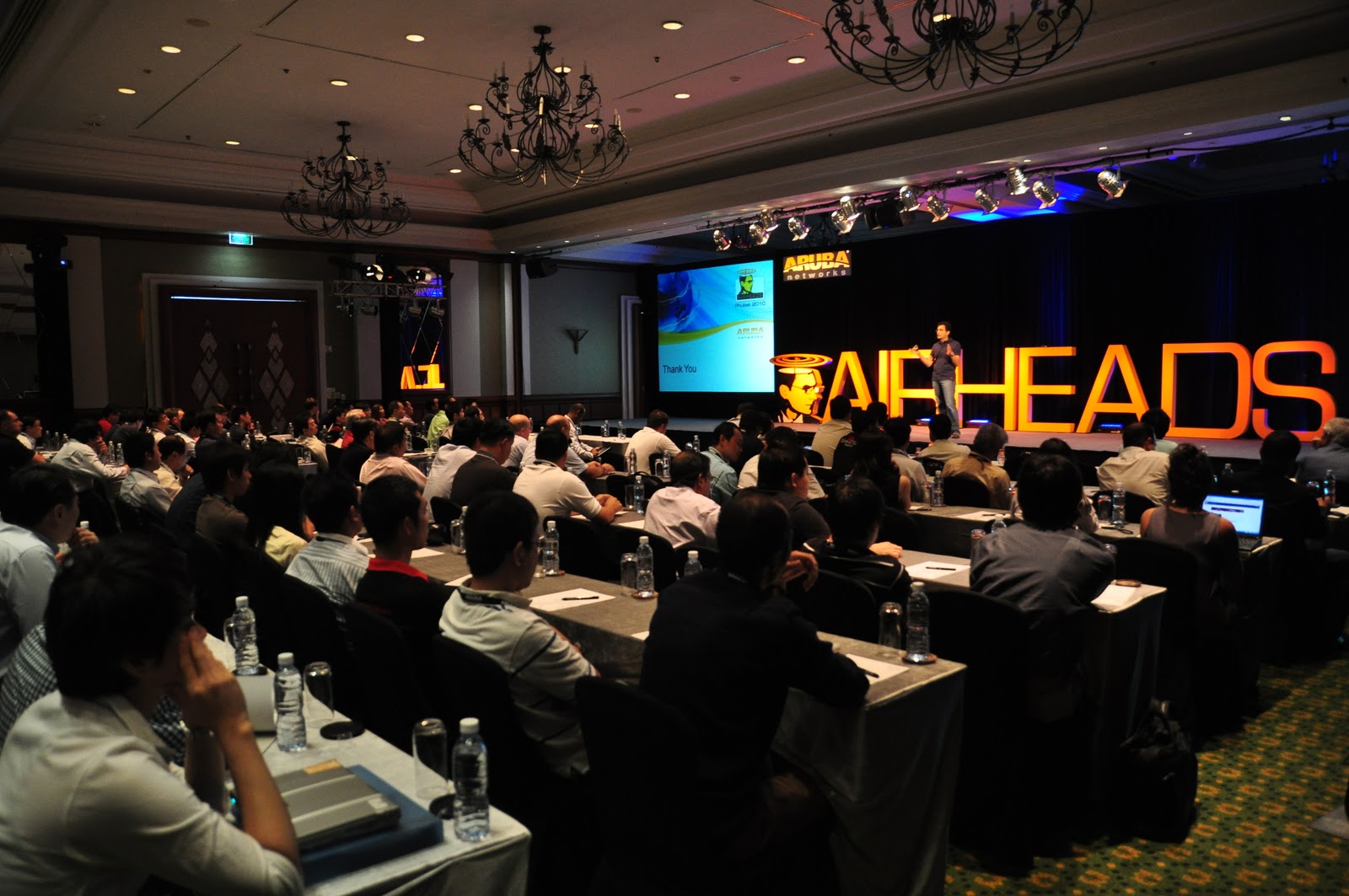
Photo Gallery of Aruba Airheads Conference 2010, Phuket Thailand

Aruba Airheads Conference, 1-3 December 2010, Phuket Thailand.


Dinner with Aruba's Co-founder Keerti Melkote.
Left: Me, Hitesh Sheth (COO), Keerti Melkote (CTO), Dr. Reza, Dr. Unggul
Back: Kevin Wong


Thursday, November 18, 2010

10 Best Security Apps for iPhone

Apple's App Store currently holds about 85,000 applications for you to download to your iPhone or iPod Touch. Of course, about 84,900 of those programs consist of free and 99-cent games that your seven-year-old would probably find more compelling than you do. So we've scoured reviews, App Store search sites, and recommendation directories to compile this concise list of some of the best security apps currently available.
EyeSpyFX has developed mobile applications that allow you to check surveillance cameras from Axis, Sony, D-Link, Linksys, Mobotix, and Vivotek. Each edition lets you set up a camera list and check the views for up to 100 cameras. You can also add cameras and bring up an edit screen to adjust camera details. When a camera goes offline, a status indicator will point that out. And the app will remember your passwords.
Price: $4.99 and less
Size: Under 0.5 MB

Thursday, October 28, 2010

How to manage AP Folder in AirWave

What is folder management ? Folder in layman term means something that we can represent as location or building or LAN Room where we can group our AP. In my case, I named it based on geographical location and buildings. Currently, I'm managing a nation wide wireless infrastructure. It is important to group all the APs in order to simplify all our works. It helps us to manage the reporting and also identifying which AP is currently down. 

Firstly you need to log on to your Airwave server. After you successfully login to the Airwave Management Platform server, you will see the user interface as below: